
India's manufacturing sector activity eased to a nine-month low in November, mainly owing to softer rise in sales and production amid reports of challenging market conditions, a monthly report said on Monday. The seasonally adjusted HSBC India Manufacturing Purchasing Managers' Index (PMI) falling to 56.6 in November from 59.2 in October, highlighted the slowest improvement in operating conditions since February.

Manufacturing activities in India remained robust and price pressures were contained in October as new orders and production rose at a slower but stronger pace, according to a monthly survey released on Tuesday. The seasonally-adjusted S&P Global India Manufacturing Purchasing Managers' Index (PMI) was up from 55.1 in September to 55.3 in October. The October PMI data pointed to an improvement in overall operating conditions for the 16th straight month.

India's manufacturing PMI rose to 54.5 in December, 2014, while in the corresponding period a year ago it stood at 50.7, just above the crucial 50 mark which separates growth from contraction.
Manufacturing activities in India touched a three-month high in November as new orders and exports expanded boosted by demand resilience and substantial easing of cost pressure, according to a monthly survey released on Thursday. The seasonally adjusted S&P Global India Manufacturing Purchasing Managers' Index (PMI) stood at 55.7 in November, up from 55.3 in October, signalling the strongest improvement in operating conditions in three months. The November PMI data pointed to an improvement in overall operating conditions for the 17th straight month.

A reading above 50 denotes expansion while one below means contraction.

Analysts predict that the ongoing conflict in West Asia, crude oil prices, and global trends will significantly influence the Indian stock market in the upcoming holiday-shortened week. Foreign investor activity and rupee movement will also be crucial.

India's services sector growth reached a five-month high in April, with the HSBC India Services PMI Business Activity Index rising to 58.8, primarily driven by robust domestic demand and a shift from international to local suppliers amidst the West Asia crisis.

The IHS Markit India Manufacturing PMI rose from 51.2 in November to 52.7 in December. Factories benefited from a rebound in demand, and responded by scaling up production to the greatest extent since May. As per the survey, new work orders witnessed marked improvement, with the pace of expansion picking up to the fastest since July.

Indian stock markets are poised for volatility this week, driven primarily by the outcomes of five state assembly elections, ongoing high crude oil prices amid West Asia tensions, and the release of Q4 corporate earnings, according to market analysts.

The expansion in total new orders was supported by greater sales to international markets

On price rise, HSBC said that the rate of cost inflation decelerated sharply while output prices were unchanged.

India's services sector growth slowed in March, reaching a 14-month low, according to the HSBC India Services PMI. The slowdown reflects weaker new business intakes and rising input costs, particularly in fuel, transport, and logistics.

The seasonally adjusted IHS Markit India Manufacturing Purchasing Managers' Index (PMI) was at 54.9 in February, up from 54.0 in January, signalling a stronger improvement in the sector's health. The February PMI data pointed to an improvement in overall operating conditions for the eighth straight month. In PMI parlance, a print above 50 means expansion, while a score below 50 denotes contraction.
India's services sector experienced a slight moderation in growth during February, according to the HSBC India Services PMI Business Activity Index, with new order growth slowing and inflation picking up.

India's manufacturing sector continued with its robust performance in November, mainly on the back of substantial easing in price pressures and strengthening demand from clients, a monthly survey said on Friday. The strong performance of the manufacturing sector is expected to continue in 2024 as well. The seasonally adjusted S&P Global India Manufacturing Purchasing Managers' Index (PMI) rose to 56 last month from the eight-month low level of 55.5 recorded in October.

A host of macroeconomic data announcements, global trends and trading activity of foreign investors would dictate investors' sentiment in the stock market this week, analysts said. Besides, auto sales data will be closely tracked, experts noted.
India's manufacturing sector growth climbed to a four-month high in January as a sharper upturn in new orders boosted output growth amid mild cost inflation, a monthly survey said on Thursday. The seasonally adjusted HSBC India Manufacturing Purchasing Managers' Index (PMI) recovered from an 18-month low of 54.9 in December to 56.5 in January. The latest reading highlighted the strongest improvement in the health of the sector since last September.
India's manufacturing sector growth moderated in August as output and sales rose at slowest rates since January, while competitive pressures and inflation concerns hampered business confidence, a monthly survey said on Monday. The seasonally adjusted HSBC India Manufacturing Purchasing Managers' Index (PMI) stood at 57.5 in August, below July's reading of 58.1 but above its long-run average of 54.0, signalling a substantial improvement in operating conditions.
The country's manufacturing sector activity grew at the slowest rate in four months during March, hampered by softer rises in new business as international demand faltered owing to the coronavirus pandemic, a monthly survey said on Thursday. The headline seasonally adjusted IHS Markit India Manufacturing PMI fell to 51.8 in March, from 54.5 in February, signalling the slowest improvement in business conditions since November 2019. This is the 32nd consecutive month that the manufacturing PMI has remained above the 50-point mark.

India's services sector growth rose to a two-month high of 58.5 in January, on faster expansion in new business intake and output, prompting service providers to hire additional staff, a monthly survey said on Wednesday.
India's manufacturing sector activity moderated in April, but still recorded the second fastest improvement in operating conditions in three-and-a-half years supported by buoyant demand, a monthly survey said on Thursday.

The Indian stock market is poised for a volatile week, influenced by the Reserve Bank of India's monetary policy decision, crucial global macroeconomic data, and the escalating geopolitical tensions in West Asia, according to market analysts.
India's services sector growth witnessed the slowest pace of expansion in five months in October, as competitive pressures and heavy rains in parts of the country led to a slower increase in output, according to a monthly survey released on Thursday.

HSBC PMI falls to 50.7, slow domestic demand offsets pick up from abroad.

Sluggish rise in new business inflows and a cautious approach to costs reportedly led Indian manufacturers to shed jobs in September.

Precious metal prices, particularly gold and silver, experienced a significant surge in the national capital as investors sought safe-haven assets amid escalating hostilities in the Middle East.

Trading sentiment in the equity market this week will be guided by global trends, foreign fund movement, macroeconomic data announcements and RBI's interest rate decision, analysts said. The monthly auto sales data announcement would also be tracked by investors this week.

A reading above 50 indicates expansion, while a score below this mark means contraction
India's services sector growth moderated in December, as the rates of expansion in incoming new work and output eased to the slowest in 11 months, and companies refrained from recruiting additional staff, a monthly survey said on Tuesday. The seasonally adjusted HSBC India Services PMI Business Activity Index fell from 59.8 in November to 58.0 in December, indicating the slowest rate of expansion since January.

From the Sensex pack, Zomato jumped nearly 5 per cent, followed by Titan which climbed almost 4 per cent. IndusInd Bank, Maruti, Tech Mahindra, Adani Ports, Bharti Airtel and HDFC Bank were also among the gainers.

Quarterly earnings, macroeconomic data announcements and global trends will drive the Indian stock markets in a holiday-shortened week, analysts said. Stock markets would remain closed on Wednesday for the Guru Nanak Gurpurab holiday.

The index has remained above the 50-mark, below which it indicates contraction, for more than three years now.

India's manufacturing sector witnessed a slowdown in July - the weakest growth rate since November - because of moderation in domestic and export orders amid sagging global economy, an HSBC survey said.
The seasonally adjusted S&P Global India Manufacturing Purchasing Managers' Index (PMI) slipped from 57.5 in September to 55.5 in October, the slowest rate of expansion since February. The October PMI data pointed to an improvement in overall operating conditions for the 28th straight month.

The Indian services sector growth touched a 15-year high in August, driven by a sharp rise in new orders and output, amid substantial improvement in demand conditions, a monthly survey said on Wednesday. The seasonally adjusted HSBC India Services PMI Business Activity Index was up from 60.5 in July to 62.9 in August, indicating the steepest rate of expansion since June 2010.
The growth momentum in India's manufacturing sector was maintained in February, with new orders and output increasing at similar rates to January, according to a monthly survey. The seasonally adjusted S&P Global India Manufacturing Purchasing Managers' Index (PMI) was at 55.3 in February, little-changed from 55.4 in January. The February PMI data pointed to an improvement in overall operating conditions for the 20th straight month. In PMI parlance, a print above 50 means expansion while a score below 50 indicates contraction.

The index, however has remained above the 50 mark - below which it indicates contraction - for more than three years now.
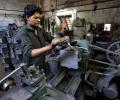
India's manufacturing sector activity rose to a 13-month high in December, supported by healthy inflows of new business and strong demand conditions, according to a monthly survey. The seasonally adjusted S&P Global India Manufacturing Purchasing Managers' Index (PMI) stood at 57.8 in December, up from 55.7 in November, as business conditions improved to the greatest extent in over two years. The December PMI data pointed to an improvement in overall operating conditions for the 18th straight month.
India's manufacturing sector growth improved in November, registering the fastest pace in five months, driven by a strong pick up in new orders and improved purchasing activity, an HSBC survey said on Monday.

India's power demand rose 4.5 per cent year-on-year (Y-o-Y) to 143 billion units (BUs) in January, marking the highest consumption for the month since 2010, primarily on the back of severe cold wave conditions across northern and eastern regions of the country.
